Translate

Wednesday, September 11, 2019

Diploma Options in Special Education in Tennessee

In the state of Tennessee, there are four different options for diplomas when you graduate from high school for students receiving special education services. These options are the regular diploma, the Alternate Academic Diploma (AAD), the Occupational Diploma, and the Special Education Diploma. If your child has an Individual Education Program (IEP), it is important to know the differences between these diplomas and what each may mean for your child's future. You'll also need to consider early on how taking alternate assessments in place of TCAP state testing will affect your child's diploma options when they get to high school.

Below is a chart created by The Arc Tennessee which shows some basic comparisons between the four diplomas. IDEA stands for The Individuals with Disabilities Education Act. This is the federal law that ensures students who receive special education services have access to a free and appropriate public education with supports and services to meet their individual education needs.

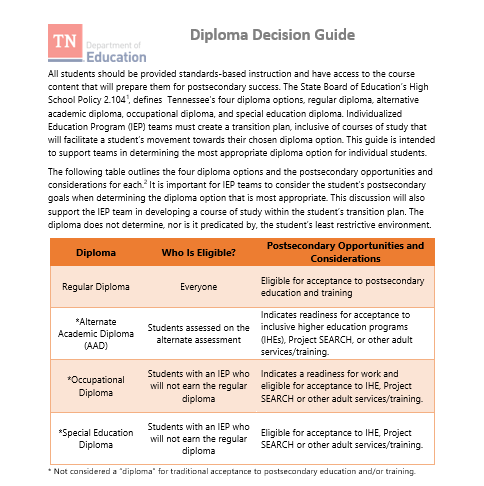
The Tennessee Department of Education recently put out a graphic to help schools and families determine the best path for each student. The second chart is new and particularly helpful. Just click on the image to open it up to a readable size.
1 Tennessee State Board of Education, High School Policy 2.104 https://www.tn.gov/sbe/rules--policies-and-guidance/policies.html 2 For additional information on the postsecondary opprotunities and considerations, visit the Parent Guide for Tennessee Diploma and Postsecondary Education Options at https://www.tnstep.org/uploads/files/STEP%20and%20TDOE%20Diploma%20and%20Postsecondary%20Options%20%20April%202018%20OS.pdf


3 Alternate Assessment https://www.tn.gov/education/assessment/alternate-assessment.html


You can learn more about the requirements for each of the diplomas from the Tennessee Department of Education at the following link (just scroll down and click on "Graduation Options"): https://www.tn.gov/education/student-support/special-education/special-education-secondary-transition.html

This chart from STEP TN gives more information about requirements for each diploma option, along with a student's post-secondary options for each: TENNESSEE DIPLOMA AND POST-SECONDARY INFORMATION

Thursday, August 22, 2019

Why Inclusion is a WIN for ALL Students!

Graphic by: https://www.tndisability.org/
Many districts are trending toward including children with disabilities in the general education classrooms as much as possible, and this is a wonderful plan for everyone involved. Including students in the Least Restrictive Environments is indeed required by law. Typical children and teachers actually benefit from this scenario as well. Here's why:

1. Inclusion teaches everyone about diversity. A classroom that's rich in diverse cultures, religions, and languages can help all students learn about these differences from an early age and embrace them. The same goes for classrooms with different abilities and neurodiversity. Students (and teachers!) learn from one another, and including a mix of students in a classroom will help everyone grow together, learn from one another, and embrace the differences that make each of them unique and special.

2. Students' attitudes and perceptions will change for the better. Many classrooms find that the typical children in an inclusion classroom will develop a greater sense of empathy and selflessness when they share a classroom with a child with disabilities.

3. Students with disabilities reach more of their goals. The teachers in the general education classroom will typically have high expectations for all of their students, so with the right supports in place, a student with disabilities will strive to meet those higher expectations. They'll also have more opportunities to learn social skills from the modeled behavior of the others students in their class.

4. Teachers will learn more about how to teach differently. Whether a child has a disability or not, they can all learn in different ways. Including a diverse mix of abilities in a classroom helps the teacher refine their skills on teaching to a wide variety of learning styles. This benefits all children in the classroom.

It's particularly important to start thinking about your child's learning environment early on. The Individuals with Disabilities Education Act (IDEA) states that students should be placed in the least restrictive environment, even if supports are required to help the student succeed. It is best practice to start in a general education classroom and scale back on the placement if the student needs that, rather than beginning in a secluded special education environment and working toward a general education placement.

The IEP Team, which the parent is an equal part of, will make the placement decision that is best for the student. Your child’s general education teacher should always be a part of the IEP Team so that their regular classroom placement can be planned for success. Stay in touch with your child’s teachers so you know what is happening day to day.  You can check out some ideas on home-school communication tools HERE.

Tuesday, August 20, 2019

Understanding Procedural Safeguards: A Guide for Families in Special Education

You probably know that your school is required to give you a copy of the procedural safeguards at least once a year if your child has an IEP. But, have you ever had to look through them? They can be a bit overwhelming and even confusing at times. The Arc Tennessee, through the Family Engagement Project, is breaking down the various parts of the Procedural Safeguards and giving families the basic idea behind each part to make it easier to understand. If you have questions about a particular topic, click the link below to learn more. If there is anything we haven't covered that you'd like to know more about, leave us a comment below and we will reach out!


First off, let's start with a link to the full version of the Procedural Safeguards. You should receive a copy of this in some form when you first meet with your child's school for the year:
CLICK HERE to read the full version.

Here's where we'll break this down into parts for you. Click on each topic to read more about what each one means for your child in special education:

Prior Written Notice

Native Language/Translation

Parental Consent

What if I don't Agree with an Evaluation?

What if I Want to Change my Child's Records?

Confidentiality of Information

State Complaint and Dispute Resolution Procedures

Procedures for Disciplining Children with Disabilities
 When you need to send your child to Private School at Public Expense


Thursday, August 15, 2019

Families can use Family Medical Leave for IEP Meetings!

Great news for working families who have children with IEPs and qualify for FMLA! The US Department of Labor recently wrote a letter which says working families who need to take time off to attend their child's IEP meeting can to do so under the Family and Medical Leave Act (FMLA). You can read the letter from the Department of Labor below.


The opinion letter says that parents who need to miss work to attend any meeting held under the IDEA (federal special education law), including IEP meetings, qualify for “intermittent leave” under the Family Medical Leave Act (FMLA). For parents who struggle to balance work and advocating for services and supports their children need at school, this news will help with flexibility to take time off from work for important school meetings.

You can read the Department of Labor Letter HERE for more information. Just be aware that in order to use FMLA for an IEP meeting, your child must have a serious health condition that will be addressed during the meeting. Not all employers are required to provide FMLA, but it doesn't hurt to ask for the time off. Generally, you should give at least 30 days notice if possible and follow your employer's procedure for requesting time off.

Thursday, August 8, 2019

Part 4: Transitioning from Middle School to High School in Special Education

This is the final big transition before your child will transition out to the real world. Congratulations on making it this far! While Middle School was probably the trickiest as far as figuring out a new way of scheduling classes and walking around to different classrooms throughout the day, now that your child has that experience under their belt, high school should be a breeze, right? Well, if you prepare yourself with these transition tips, it should be a very smooth transition for all involved.

1. Find out if your district has a formal plan for transitioning into High School.

You may find that you'll save yourself some time if they already have a plan in place. Review the plan and see if this will work well for you and your child. This plan may involve a special orientation meeting, often called a bridge meeting, you can set up before school starts. You'll need to consider if one meeting will be enough for your child, or if you should go in with your child to tour the school an additional time. Some families like to do this at the beginning of the summer to take photos that your child can review throughout the summer to help them better prepare for this new environment. So, if your district DOES have a plan, learn about it and see if you need to add any extra accommodations or modifications for your child to execute that plan more successfully.

2. Schedule your first IEP Team Meeting.

You should get this scheduled as early as possible so you can address any new areas of concern or opportunities for new goals, accommodations, or modifications that you think your child should have in place. You can request that the high school invite your child's middle school special education teacher to attend and share information about your child. You'll want to consider asking about things such as transportation, where your child will eat lunch and with whom, class schedule and elective options, looking ahead to an alternate academic diploma and state testing, etc.

3. Set up meetings with teachers before school starts.

This is a great opportunity to encourage your child to self-advocate if you want to have them reach out to their teachers on their own to arrange this meeting. They can come up with a list of questions they have for their teachers and have it ready for the meeting. This will provide them with some experience in greater independence which will come in handle throughout their high school journey.

4. Arrange a tour of the school.

Just like in middle school, this is an important step to take so that your child can see the new campus and map out an idea of their day. If you weren't able to arrange this during the bridge meeting, you may want to set this up toward the end of summer but before students return to school. You should walk to important places like restrooms, cafeteria, classrooms the main office, nurse's office, etc. If it helps for your child to have photos of these locations to review before starting school, take them at this time. If you have his/her schedule set, you could also make a photo map of their day to help them prepare.

5.  Start encouraging self-advocacy.

This will most likely be the school where your child will turn 18 and become and adult. This is a great time (if not sooner) to start practicing self-advocacy. Ask your child what their goals are for high school. Encourage them to plan for questions or comments they'd like to share during the meetings you have scheduled. Developing these skills early on will help them prepare for the world beyond high school.

6. Check out these resources to help you prepare for success:


Thursday, July 18, 2019

Part 3: Transitioning from Elementary to Middle School in Special Education

Transitioning from Elementary to Middle School in Special Education can be a particularly challenging time in your child's educational journey if you aren't prepared for the big changes that come along with this. New BIG school, new (and more frequent) transitions, new responsibilities, etc. We understand that it can seem daunting, but with the right preparation you and your child can get through this time successfully and as smoothly as possible. In this blog post, we are sharing some tips for navigating this transition along with some additional resources that you might find helpful.
 

1. Start thinking early about your child's biggest challenges in elementary school so you can tackle them first. 

You know your child best, and your child's elementary school team can probably offer some helpful tips on this, so start thinking about it early. Some things to keep in mind about middle school:
  • There may be more classwork and homework
  • Students are expected to be more independent and responsible for keeping track of many different classes/teachers at once
  • Scheduling becomes more complicated - students may be changing classrooms for the first time
  • Organizational skills can be put to the test with various handouts and assignments from all the different classes
  • The school building may be larger with more students and it may take a while to learn to navigate
  • Let's not forget the changes associated with reaching puberty age
Keep these potential challenges in mind. If your child needs help with these things it's ok to ask. Working with your elementary IEP team, you can make a list of accommodations or modifications you'd like to ask for when you meet with the Middle School IEP team that will help with any potential issues that may arise.

2. Reach out to the Special Education Teacher at the Middle School to see if you can set up a meeting.

If possible, invite the special education teacher at the middle school to a year-end IEP Team Meeting at your child's elementary school. If that doesn't work out, see if they are able to meet with you before school starts. This can be a great way to bring your child to the school and get them familiar with the building and staff. You can go over any of the potential challenges you discussed with the elementary school and schedule an IEP Team Meeting to get your child's goals and any necessary accommodations in place.

3. Set up a school site visit.

This is something great to do while school is still in session so your child can get a feel for how the hallways flow and where the students gather, etc. You might consider doing this more than once to really prepare them. If you get your child's schedule in advance you can see about scheduling a time before school starts to visit the school and walk them through their schedule so they can see where all the classrooms are located. This would also be a great time to show them where there locker is located, where they'll eat lunch, etc.

4. Schedule the IEP meeting.

It's a good idea to get this down on the books so you know when it's coming. During the meeting you'll want to discuss your goals and concerns with this big transition. Find out your child's schedule. Talk about needed modifications or accommodations. You might even want to invite your child's elementary school special education teacher to a beginning of school Middle School IEP Team Meeting so they can share what they know about your child.

5. Read up on these tips from other resources.


We hope that these tips help set you off in the right direction as you prepare your child for Middle School. If you have any questions or would like to share other helpful tips, you can leave them in the comments below or email me at japrea@thearctn.org.

Be sure to check out all of the other resources offered on our blog and follow us on social media to help guide you on your special education journey! As parents/caregivers, you play an important role in your child's road to success.

CLICK HERE TO FOLLOW ON FACEBOOK: www.facebook.com/fespedtn
CLICK HERE FOR MORE BRIDGING TIPS TO OTHER GRADE LEVELS:
https://fespedtn.blogspot.com/2019/06/bridging-tips-in-special-education.html

Friday, June 14, 2019

Part 1: Transitioning from TEIS to Pre-School


When children transition from TEIS (Tennessee Early Intervention Services) into Preschool Services in the special education system in public schools, it can be a challenging time. Families do not always know where to begin. We will lay out a few helpful tips for getting started so you can rest easy knowing you will have your ducks in a row before your child turns 3 so you will be ready to leave behind the world of home-based services for a whole new world in a classroom!

1. Prepare for your child's first IEP (Individualized Education Program) meeting: Before your child turns 3 years old, your TEIS service coordinator will arrange for a transition IEP meeting if your child will continue to qualify for services in pre-school. Make sure you schedule this for a time that will work with your schedule so you can attend. Decide if you'd like to have anyone else there with you to help advocate for your child. Ideally this should be someone who knows you and your child.

2. Have your child's medical records ready: When you do set up your IEP meeting, you will want to make sure you share any outside evaluations and assessments your child has completed. The school will provide necessary evaluations as well to help identify what services your child will need. Some schools will only accept evaluations that they complete, but it is helpful to share your child’s medical records with your child’s IEP Team.

3. Understand LRE (Least Restrictive Environment): LRE is different for every child. This will be a big part of what you will want to discuss in your IEP meeting since it will determine where your child spends their time in the classroom. Click here for more info on LRE.

4. Complete all registration forms on time: Many school districts now offer online registration. If your school does not offer that yet, make sure you stop by your school’s office and pick up the packet of paperwork you will need to fill out and get it back as soon as possible. This allows for the school to have the information they need on all students who will be joining them in the Fall.

5. Visit the school: Your child's new school should welcome a visit from your family before your child starts. This will make everyone more comfortable during this transition because the teachers and staff will get to know you and your child, and you will get to know them. Just call the school office and set up a time. This is a great opportunity to make sure the school is a good fit for your child, and you can make sure that the environment truly is the least restrictive option for your child. If you have any concerns, be sure to speak up!


While this transition is one filled with big changes, the everyone’s goal is to see your child succeed and thrive in school! By being here and reading this post, you are already well on your way toward becoming more prepared. Good job on being dedicated to your child's education! For more information on how to stay engaged at school, be sure to follow us on social media: www.facebook.com/fespendtn

"Say Dyslexia" Law

  In 2016, the Tennessee legislature passed a law that is also referred to as the “Say Dyslexia” law. The law requires schools to screen for...